
MetLife Stadium: World Cup 2026 Final Venue Guide
Loading...
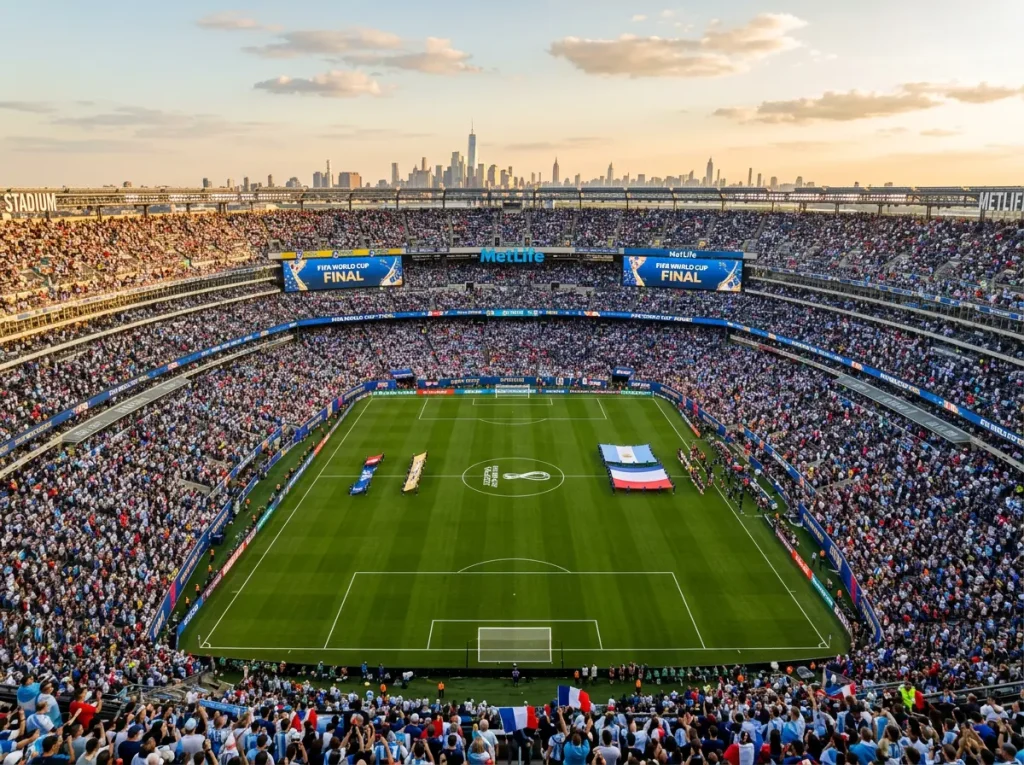
July 19, 2026 — that’s when the biggest single sporting event on the planet reaches its conclusion inside MetLife Stadium. The FIFA World Cup Final at this New Jersey venue will draw a global audience exceeding one billion viewers, making every betting angle around this match subject to unprecedented liquidity and sharp action. Understanding what MetLife Stadium brings to the occasion helps you navigate the most heavily wagered football match in history.
The venue selection for the World Cup Final wasn’t arbitrary. MetLife Stadium offers the largest seating capacity of any North American venue in the tournament, proximity to the New York metropolitan area’s massive population base, and infrastructure capable of handling the security and broadcast demands of global football’s pinnacle event. For Canadian bettors investing in outright winner futures or planning late-tournament plays, this venue profile matters substantially.
MetLife Stadium — The Final Stage
New Jersey’s MetLife Stadium sits eight miles west of Manhattan, technically outside New York City but functionally serving as the region’s premier sporting venue. The Giants and Jets of the NFL call this stadium home, and that football pedigree translates directly to World Cup readiness. The venue has hosted Super Bowls, international friendlies, and Copa América matches — but nothing approaches the magnitude of what July 19 will bring.
Capacity for the World Cup Final will reach approximately 87,000, making this the largest crowd at any 2026 tournament match. The sheer volume of supporters creates atmosphere unlike smaller venues, though the sound dispersion in MetLife’s open bowl differs from compact European stadiums. Noise doesn’t concentrate as intensely as at enclosed venues like BC Place, but the visual spectacle of 87,000 partisans generates its own psychological weight.
The stadium opened in 2010, replacing the legendary Giants Stadium that hosted 1994 World Cup matches including the Italy vs Bulgaria semifinal. That historical connection matters to FIFA traditionalists who remember the previous American World Cup fondly. MetLife represents an upgrade in every measurable facility category while maintaining the Meadowlands sports complex location that served the 1994 tournament effectively.
Structurally, MetLife Stadium is an open-air venue without retractable roof — a deliberate design choice that reduces operational complexity while accepting New Jersey’s July weather risks. The playing surface will be natural grass installed specifically for World Cup matches, replacing the artificial turf used during NFL season. This temporary grass installation follows FIFA requirements and has been successfully implemented for previous international matches at the venue.
The altitude sits at just 2 metres above sea level, creating no physiological challenges for any team reaching the Final. Combined with July temperatures typically ranging from 23°C to 30°C, the conditions approximate what European and South American teams experience during their domestic summer competitions. No excuses about altitude or unusual climate exist for teams playing the World Cup Final at MetLife.
All Confirmed Matches Including the Final
MetLife Stadium’s World Cup allocation extends well beyond the Final, with the venue hosting multiple group stage and knockout fixtures that build toward the tournament’s climax. This heavy utilization means the playing surface must maintain quality through approximately two dozen events over 39 days — a significant turf management challenge that venue operators have prepared for extensively.
Group stage matches at MetLife feature several high-profile fixtures involving traditional powers. The venue’s capacity makes it ideal for matches where demand exceeds what smaller stadiums can accommodate. The exact group stage schedule places matches from Groups C, D, and L at MetLife, including fixtures involving teams like Brazil, USA, England, and Croatia during the opening phase.
The knockout round allocation positions MetLife Stadium for maximum drama. A Round of 16 match on July 6 begins the venue’s elimination phase hosting. Quarterfinal fixtures follow on July 11, with the bracket structure potentially bringing favoured teams through this path. The semifinal on July 15 sets up the ultimate fixture four days later.
The World Cup Final on July 19 kicks off at 16:00 ET, a timing choice that accommodates global broadcast windows. European audiences watch in their evening prime time. Asian and Middle Eastern viewers get late night coverage. The afternoon start means the match concludes before sunset, with natural lighting throughout and potential golden hour aesthetics during the trophy presentation.
For betting purposes, the heavy match allocation means MetLife Stadium conditions become well-understood by tournament’s end. Any pitch deterioration, unusual wind patterns, or crowd behaviour tendencies will be apparent from earlier matches. Bettors tracking the venue through group and knockout stages accumulate information that informs Final wagers — an advantage over casual observers who only tune in for the championship match.
Venue Profile and History
MetLife Stadium’s design prioritizes spectator experience and NFL operational requirements, which translates interestingly to football context. The bowl configuration seats supporters relatively close to the pitch despite the massive capacity, avoiding the cavernous feel of some 80,000-plus venues. Sightlines from upper decks remain acceptable for football viewing, though nosebleed sections present challenges for detailed play observation.
The corporate investment in MetLife Stadium exceeds $1.6 billion USD, making it among the most expensive sporting venues ever constructed. That investment shows in infrastructure quality — reliable connectivity, excellent concession access, comfortable seating standards, and robust safety systems. World Cup operational requirements layer onto this foundation rather than requiring fundamental upgrades.
International football at MetLife has included prestigious friendlies and tournament matches. The venue hosted 2016 Copa América Centenario fixtures including Argentina vs Chile, providing a template for World Cup atmosphere expectations. Those matches drew passionate South American crowds who transformed the typically NFL-focused atmosphere into something more closely resembling Buenos Aires or Santiago.
The transition from NFL artificial turf to World Cup natural grass represents the most significant venue modification. This process begins weeks before the tournament opens, with sod installation and cultivation creating a playing surface that meets FIFA certification. Similar installations at other NFL stadiums for international matches have produced quality surfaces, though July heat stress and heavy match scheduling create maintenance pressures.
New York metropolitan area transportation serves MetLife Stadium through multiple channels. NJ Transit rail delivers supporters directly to the Meadowlands Sports Complex station adjacent to the venue. Bus services from the Port Authority and surrounding regions supplement rail capacity. Parking on the venue’s massive lots remains available but ill-advised for events of Final magnitude — transit represents the practical choice.
What to Know for the World Cup Final
The World Cup Final differs from every other match in the tournament, and MetLife Stadium’s role as host venue shapes the betting landscape in specific ways. Neutral venue dynamics dominate, with neither finalist enjoying home advantage. This neutrality simplifies some betting considerations while complicating others.
Crowd composition at the Final depends entirely on which teams advance, but certain patterns are predictable. The New York metropolitan area’s demographic diversity means substantial supporter bases exist for virtually any traditional power. Brazilian, Argentine, English, Mexican, German, and numerous other diaspora communities can fill significant sections if their nations reach the Final. This creates something approaching home atmosphere for certain matchups while maintaining neutrality for others.
The 16:00 ET kickoff means July afternoon sun exposure during the first half, with the sun setting behind the western stands during the second half. Teams playing into the sun for 45 minutes face legitimate visibility challenges, though MetLife’s open bowl allows some shadow relief. The coin toss for ends selection carries slightly more tactical weight than at enclosed venues or evening matches.
July weather in the New Jersey Meadowlands typically delivers warm, humid conditions. Temperatures in the high 20s Celsius combine with substantial humidity, creating fatigue factors that intensify as matches progress. Teams reaching the Final after difficult semifinal matches may show more second-half fade than well-rested opponents. This physiological stress favours depth, fitness preparation, and tactical approaches that manage tempo effectively.
The playing surface by July 19 will have endured nearly 40 days of tournament use. While the grass installation and maintenance protocols are professional-grade, some deterioration is inevitable. The centre circle and goal areas typically show the most wear. Bettors should monitor surface condition reports from later knockout matches to assess whether pitch quality might influence Final tactics or increase injury risks.
Venue Factors for Bettors
Betting the World Cup Final requires synthesizing four weeks of tournament information, and MetLife Stadium’s characteristics should feature in that analysis. The venue creates specific conditions that favour certain team profiles while disadvantaging others.
The natural grass surface, even with late-tournament wear, benefits teams preferring technical football over physical confrontation. The pitch will play somewhat slower than artificial surfaces at venues like BC Place, allowing midfielders more time on the ball. Teams with elite passers and patient buildup tendencies gain marginal advantages on this surface profile.
The open-air environment and afternoon start mean weather becomes a variable. Rain forecasts should trigger consideration of how finalists have performed in wet conditions during the tournament. Humidity levels affect pressing intensity, pushing teams toward mid-block defensive shapes rather than high-pressure approaches. Teams whose tactical identity depends on relentless pressing may find conditions challenging.
The massive crowd creates atmospheric intensity without concentrated acoustic pressure. Unlike enclosed venues where 50,000 voices create unbearable decibel levels, MetLife’s 87,000 spread across an open bowl produces volume without the cave-like amplification. Teams that struggled with hostile atmospheres during the tournament may find Final conditions slightly less oppressive than earlier rounds.
Neutral venue dynamics eliminate home advantage calculations, simplifying moneyline analysis to pure squad quality and tactical matchup assessment. This removes a variable that heavily influenced group stage and early knockout pricing. Finalists face each other on genuinely equal terms — no crowd advantage, no travel fatigue differential, no unfamiliar surface. The better team on the day wins, full stop.
For Canadian bettors who followed their national team through group stages, the Final may or may not involve familiar participants. Regardless, understanding MetLife Stadium’s characteristics allows informed wagering on whoever emerges from the knockout rounds. The venue doesn’t change based on finalists, making this analysis evergreen once absorbed.
The group stage structure ultimately determines which bracket paths lead through MetLife Stadium to the Final. Understanding how group winners and runners-up feed into the knockout bracket helps identify early which potential finalists would carry venue familiarity into the championship match — those having played MetLife group or knockout fixtures before July 19.