
Spain Wins World Cup 2026 — Final Recap & Tournament Wrap
 Available in US
Spain are world champions. La Roja defeated Argentina 1-0 in extra time at MetLife Stadium on July 19, clinching their second World Cup title and capping the largest tournament in football history. For Canadian fans who watched across TSN’s 104-match broadcast, the final delivered drama, a red card, and a substitute’s goal that will define Spanish football for a generation.
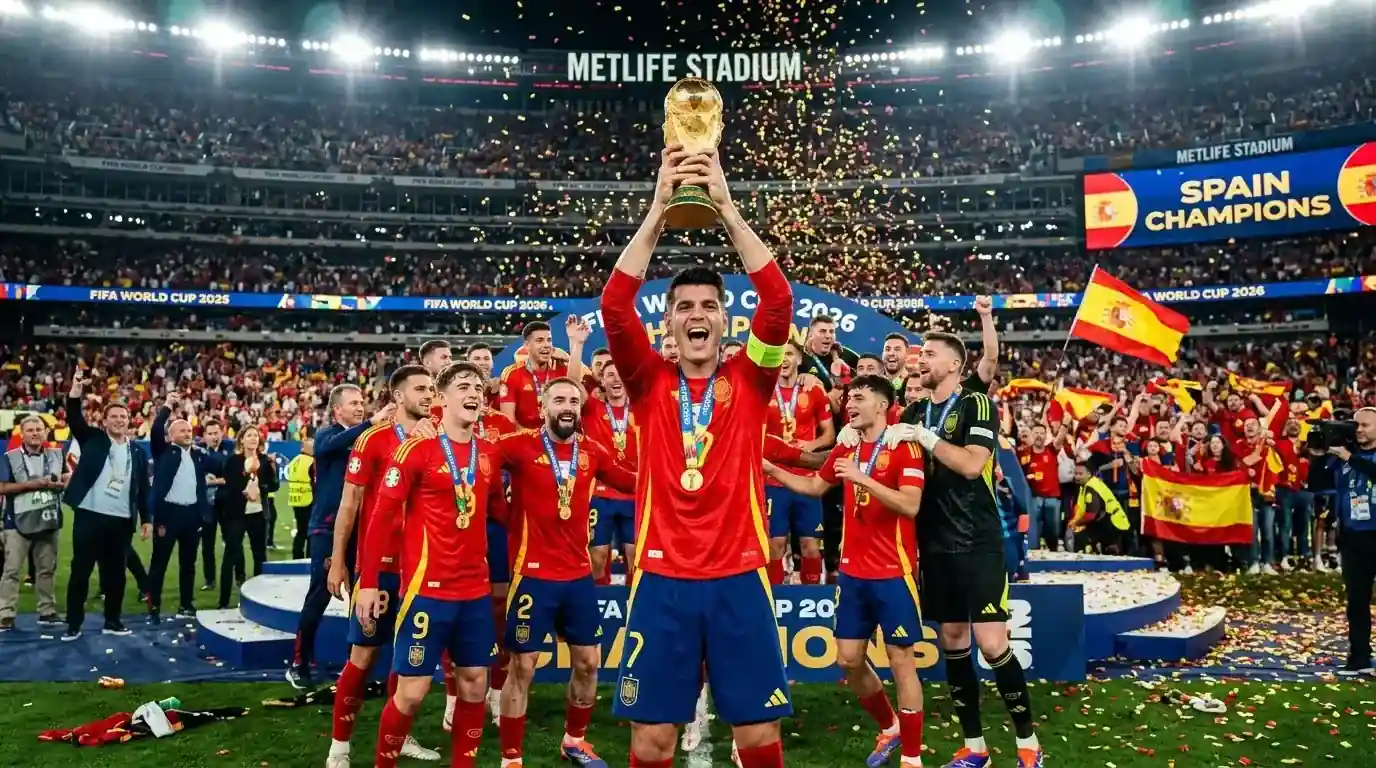
Spain lift the World Cup trophy after Ferran Torres’ extra-time winner secured a 1-0 victory over Argentina in the 2026 final.
What You Need to Know in 30 Seconds
- Spain won World Cup 2026, defeating Argentina 1-0 in extra time (Ferran Torres 106′)
- Final standings: 1. Spain, 2. Argentina, 3. England (beat France 6-4), 4. France
- Spain set defensive records: only 1 goal conceded in 8 matches, 7 clean sheets
- Argentina played in 10 men after Enzo Fernández’s red card (90+3′)
- Spain’s 38-match unbeaten streak is now the all-time international record
- Outright winner betting favourite Spain (1.67) justified pre-final odds
How Spain Won the Final
The match stayed scoreless through 90 minutes, with Argentina failing to register a single shot on target across the entire 120 minutes. Spain’s Unai Simón faced minimal threat, while at the other end Emiliano Martínez made 11 saves — the most by any goalkeeper in a World Cup final.
The decisive moment came 39 seconds into the second period of extra time. Pedro Porro’s cross from the right found substitute Nico Williams at the far post; his header across goal reached fellow substitute Ferran Torres, who fired first-time past Martínez with his left foot. Two players who started on the bench combined to deliver Spain’s second world title.
Argentina had been reduced to 10 men in stoppage time of normal play when Enzo Fernández received a second yellow card for a challenge on Pau Cubarsí that sent the 19-year-old Barcelona defender airborne. Playing the entire extra-time period a man down, Argentina could not find a route back.
Final Tournament Standings
| Position | Team | How Decided |
|---|---|---|
| 1st (Champion) | Spain | Defeated Argentina 1-0 (a.e.t.), July 19 |
| 2nd | Argentina | Lost final |
| 3rd | England | Defeated France 6-4, July 18 |
| 4th | France | Lost bronze-medal match |
The third-place match on July 18 produced the tournament’s highest-scoring game: England’s 6-4 victory over France featured 10 goals, the most in a single World Cup match since 1982. Bukayo Saka’s hat-trick led England to their best finish since winning the tournament in 1966.
Spain’s Path to Glory
Spain won all eight matches at the tournament, conceding just one goal — the fewest ever by a World Cup champion. Their defensive record included seven clean sheets, with Unai Simón setting a 96-year record for shutouts in a single tournament.
Their knockout run:
- Round of 32: Spain 3-0 Austria
- Round of 16: Spain 1-0 Portugal
- Quarter-final: Spain 2-1 Belgium
- Semi-final: Spain 2-0 France
- Final: Spain 1-0 Argentina (a.e.t.)
La Roja now hold both the men’s World Cup and Euro 2024 title simultaneously. Combined with Spain’s women’s team winning the 2023 Women’s World Cup, Spain becomes the first nation in history to hold both men’s and women’s World Cups at the same time.
Spain’s unbeaten streak reached 38 matches with the final victory, surpassing Italy’s previous record of 37 and establishing a new all-time international benchmark.
Argentina’s Title Defence Falls Short
Argentina entered the final as defending champions but could not become the first nation to retain the World Cup since Brazil in 1958 and 1962. Despite Lionel Messi’s eight goals in the tournament, La Albiceleste managed no shots on target across 120 minutes against Spain’s defence.
The red card to Enzo Fernández in the 90+3rd minute forced Argentina to play all 30 minutes of extra time with 10 men. The challenge on Cubarsí — his second yellow card offence — left Argentina unable to generate attacking pressure when they needed it most.
Emiliano Martínez, reportedly playing with a broken finger, made 11 saves to keep Argentina in the match through regulation time. His performance set a World Cup final record for saves, but it was not enough to preserve Argentina’s title.
Tournament Records and Milestones
World Cup 2026 was the first edition with 48 teams and 104 matches, played across venues in the United States, Canada, and Mexico. The expanded format produced historic numbers:
- Total goals: 308 (most ever in a single tournament; 2.96 per match)
- Total attendance: 6,810,966 (all-time record; average 65,490 per match)
- Most goals by a player: Kylian Mbappé (10)
- Fewest goals conceded by champion: Spain (1 in 8 matches)
- Longest unbeaten run: Spain (38 matches)
- Most clean sheets in one tournament: Unai Simón (7)
The final itself drew 80,663 to MetLife Stadium in East Rutherford, New Jersey. Canadian viewers across all time zones followed on TSN, which held exclusive Canadian broadcast rights for all 104 matches.
What the Final Meant for Betting Markets
Spain entered the final as favourite to lift the trophy at odds of 1.67 (FanDuel closing line), with Argentina at 2.30. The favourite delivered, though bettors who took Spain to win in 90 minutes (2.25–2.30) saw the match go scoreless through regulation.
The 90-minute 1X2 market settled as a draw (X), while the outright "to lift trophy" market (including extra time and penalties) paid on Spain as expected. The final justified the pre-tournament consensus: Spain were favourites from the quarter-final stage onward and won every knockout match.
Anytime goalscorer markets saw long-odds value from Ferran Torres, who was not in the starting XI and came on as a 62nd-minute substitute. Pre-match favourites to score — Lionel Messi (2.50), Mikel Oyarzabal (2.60), Lamine Yamal (3.30) — all failed to find the net.
The under 2.5 goals market won comfortably; the match produced just one goal across 120 minutes. For Canadian bettors who backed Spain at decimal odds throughout the knockout stages, the final closed a profitable tournament run on La Roja.
Canadian Perspective: Watching History from Home
Canada’s own World Cup journey ended in the group stage, but the tournament’s significance for Canadian football remains profound. As co-hosts alongside the United States and Mexico, Canada welcomed the world to Toronto’s BMO Field and Vancouver’s BC Place.
Canadian fans watched 104 matches on TSN, the exclusive domestic broadcaster. The final’s 3:00 PM ET kickoff on a Sunday afternoon made it accessible across all Canadian time zones, from Newfoundland (4:30 PM NDT) to British Columbia (12:00 PM PDT).
Spain’s victory marks the end of the largest World Cup ever staged. The 48-team format brought football to a scale never before seen, and Canada’s role as co-host introduced millions of Canadians to the sport’s pinnacle event on home soil.
What’s Next
Spain return to Madrid as world champions, holding both the World Cup and the European Championship. Head coach Luis de la Fuente, who guided Spain to Euro 2024 glory just two years earlier, has now delivered both major trophies within a 24-month span.
Argentina must regroup after falling short of back-to-back titles. Lionel Messi, 39, has not confirmed whether this was his final World Cup, though the tournament is widely considered his last. Manager Lionel Scaloni has confirmed he will remain in charge.
The next World Cup takes place in 2030, co-hosted by Spain, Portugal, and Morocco (with opening matches in Uruguay, Argentina, and Paraguay to mark the tournament’s centenary). Spain will enter as defending champions.
For Canadian bettors, the 2026 tournament delivered on entertainment, records, and betting interest. The settled markets now shift to club football and the start of qualifying cycles for the next edition.
Next Steps for Bettors
- Review settled outright markets — check which pre-tournament and in-play futures tickets cashed (Spain winner, Mbappé top scorer, Simón Golden Glove)
- Assess ROI on knockout-stage bets — Spain won all five knockout matches; backers who rode them from the Round of 32 onward saw consistent returns
- Study what worked — low-scoring finals, favourites in knockout ties, unders in defensive matchups all paid
- Prepare for club football — domestic leagues resume in August; carry forward lessons from knockout-tournament betting
- Monitor 2030 qualifying — World Cup qualifying begins in 2027 for most confederations; early futures markets will open within months
Spain’s World Cup victory closes the 2026 tournament. The settled markets, the records, and the drama now pass into history — and Canadian bettors who followed the action from group stage to final can assess a summer of football that will not be matched in scale for another four years.
