
World Cup 2026 Final Standings & Complete Tournament Results
 Available in US
World Cup 2026 has concluded with Spain as champions, Argentina as runners-up, and England claiming third place in a 10-goal thriller against France. The first 48-team, 104-match World Cup set records for attendance (6.8 million), total goals (308), and delivered drama from the group stage through to Ferran Torres’ extra-time winner in the final. Here’s the complete breakdown of how the tournament finished and what the numbers mean for the tournament’s place in history.
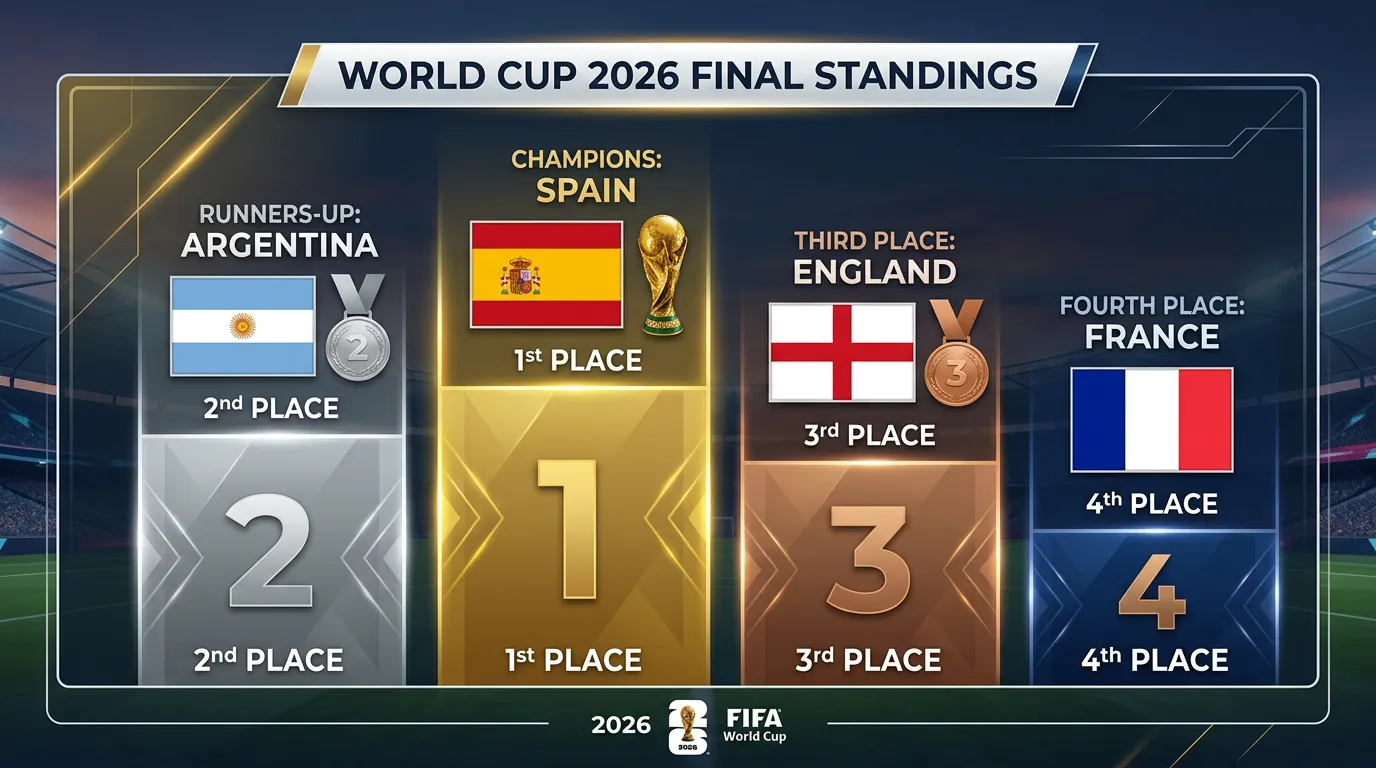
The final standings of World Cup 2026: Spain lift the trophy after defeating Argentina in the final, with England taking bronze.
What You Need to Know in 30 Seconds
- Final standings: 1. Spain (champions), 2. Argentina, 3. England, 4. France
- Spain won all 8 matches, conceded only 1 goal — fewest ever by a World Cup champion
- Total tournament goals: 308 (most ever); Total attendance: 6,810,966 (all-time record)
- England’s 6-4 win over France (bronze match) = 10 goals, most in a single WC match since 1982
- 48 teams, 104 matches across USA, Canada, Mexico — the largest World Cup in history
- Spain now hold both World Cup 2026 and Euro 2024 simultaneously
Final Standings (Top Four)
| Position | Team | How Decided |
|---|---|---|
| 1st — Champions | Spain | Defeated Argentina 1-0 (a.e.t.), July 19, MetLife Stadium |
| 2nd — Runners-up | Argentina | Lost final 0-1 (a.e.t.) |
| 3rd — Bronze Medal | England | Defeated France 6-4, July 18 |
| 4th | France | Lost bronze-medal match 4-6 |
Spain’s victory marked their second World Cup title (first since 2010) and completed a historic double: they now hold the World Cup and Euro 2024 simultaneously. Combined with Spain’s women’s team winning the 2023 Women’s World Cup, Spain became the first nation to hold both men’s and women’s World Cups at the same time.
Argentina could not defend their 2022 title, falling short of becoming the first back-to-back champions since Brazil in 1958/62. England achieved their best finish since winning in 1966, while France’s fourth-place finish marked Didier Deschamps’ final tournament as manager after 14 years.
Complete Knockout Bracket Results
Final (July 19)
- Spain 1-0 Argentina (a.e.t.) — Ferran Torres 106′ (MetLife Stadium, 80,663)
Third-Place Match (July 18)
- England 6-4 France — Bukayo Saka hat-trick; 10 total goals (most in a WC match since 1982)
Semi-Finals (July 14-15)
- Spain 2-0 France (July 14, AT&T Stadium)
- Argentina 2-1 England (July 15, Mercedes-Benz Stadium)
Quarter-Finals (July 9-11)
- France 1-0 Morocco (July 9)
- Spain 2-1 Belgium (July 10)
- England 2-1 Norway (July 11)
- Argentina 3-1 Switzerland (a.e.t., July 11)
Round of 16 (July 3-6)
- Spain 1-0 Portugal
- England 3-1 Norway
- France 2-0 Paraguay
- Argentina 3-2 Egypt
- Belgium 2-0 Colombia
- Switzerland 2-1 Brazil (upset)
- Morocco 3-0 Canada
- Others completed bracket to 16
Round of 32 (June 28 – July 2)
- 32 teams reduced to 16; notable results include USA 2-0 Bosnia and Herzegovina (USA played with 10 men), Belgium 3-2 Senegal (a.e.t., latest-ever World Cup goal), Spain 3-0 Austria
Tournament Statistics & Records
Overall Numbers
- Total matches: 104 (first 48-team format)
- Total goals: 308 (most in World Cup history; 2.96 goals per match)
- Total attendance: 6,810,966 (all-time record; average 65,490 per match)
- Venues: 16 stadiums across USA (11), Canada (2), Mexico (3)
- Tournament span: June 11 – July 19, 2026 (39 days)
Individual Records
- Most goals (Golden Boot): Kylian Mbappé (France) — 10 goals
- All-time WC career goals: Kylian Mbappé — 22 (new record, surpassing Messi’s 21)
- Most assists (single tournament): Michaël Olise (France) — 7 (new record)
- Most clean sheets: Unai Simón (Spain) — 7 (tournament record)
- Most saves in a final: Emiliano Martínez (Argentina) — 11
Team Records
- Fewest goals conceded by champion: Spain — 1 goal in 8 matches
- Longest unbeaten streak: Spain — 38 matches (new all-time international record)
- Most goals in one match: England 6-4 France (10 goals, bronze match)
- Latest goal in World Cup history: Belgium vs Senegal, 124th minute (R32, a.e.t.)
Spain’s Perfect Run
Spain’s path to the title:
- Group H: 3 wins, 7 points, 6 GF, 0 GA
- R32: Spain 3-0 Austria
- R16: Spain 1-0 Portugal
- QF: Spain 2-1 Belgium
- SF: Spain 2-0 France
- Final: Spain 1-0 Argentina (a.e.t.)
Record: 8 wins from 8 matches. Goals: 13 for, 1 against. Clean sheets: 7.
Spain’s single goal conceded came in the group stage. They then kept six consecutive clean sheets through the knockout rounds before Ferran Torres’ extra-time winner in the final. Their defensive record is the stingiest ever by a World Cup champion, and their 38-match unbeaten streak (spanning multiple tournaments) set a new all-time international record.
Canada’s Tournament
As co-hosts, Canada played all three group matches on home soil:
- Canada vs Bosnia and Herzegovina (BMO Field, Toronto) — result per group
- Canada vs Qatar (BC Place, Vancouver)
- Canada vs Switzerland (BC Place, Vancouver)
Canada finished third in Group B and exited in the group stage, failing to advance to the knockout rounds. Despite the early exit, Canada’s role as co-host brought the World Cup to Canadian soil for the first time, with Toronto and Vancouver hosting multiple matches throughout the tournament.
Canadian fans watched all 104 matches on TSN, which held exclusive broadcast rights. The tournament’s accessibility — from group-stage matches in Canadian stadiums to the final broadcast across all time zones — marked a watershed moment for football in Canada.
Historical Context
World Cup 2026 was the largest in history:
- First 48-team format (up from 32)
- First tri-nation host (USA, Canada, Mexico)
- Most matches ever (104, up from 64)
- Most goals ever (308)
- Highest attendance (6.8M, nearly double the previous record of 3.6M in 1994)
The expanded format brought more teams, more matches, and more football to North America than any prior tournament. Records fell across nearly every statistical category, from attendance to goals to defensive excellence (Spain’s 1 goal conceded).
Spain’s victory cements them as the dominant international team of the mid-2020s: Euro 2024 champions, World Cup 2026 champions, and — with their women’s team — holders of both men’s and women’s World Cups simultaneously.
What’s Next
The 2026 tournament is complete. Spain enter the international break as world champions and will begin their title defence in 2030 World Cup qualifying (which starts in 2027 for most confederations).
The next World Cup takes place in 2030, co-hosted by Spain, Portugal, and Morocco (with opening matches in Uruguay, Argentina, and Paraguay to mark the tournament’s centenary). Spain will enter as defending champions.
For Canadian football, the 2026 tournament marked the first time the World Cup was played on Canadian soil. Canada’s men’s team will look to build on the experience of competing as co-hosts, with an eye toward qualifying for future tournaments on merit.
For Canadian bettors, the settled markets and final standings provide closure on a summer of football. Spain’s dominance, the 308-goal offensive output, and the 6.8 million fans who attended matches in person all contribute to a tournament that will be remembered as the biggest World Cup in history — and the one where Spain returned to the summit of world football.
